Port Macquarie’s evolving CBD and what it means for commercial property
Port Macquarie’s CBD has historically been characterised by low-rise development, tourism-led retail, and a coastal town centre feel. However, a combination of population growth, housing pressure, evolving planning policy and renewed developer activity suggests the city centre may be entering a new phase of urban intensification.
While Port Macquarie remains well behind larger regional centres in terms of built form and density, recent planning initiatives and development proposals indicate the market is beginning to test a more mature mixed-use future.
Strategic planning is signalling a more intensive CBD future
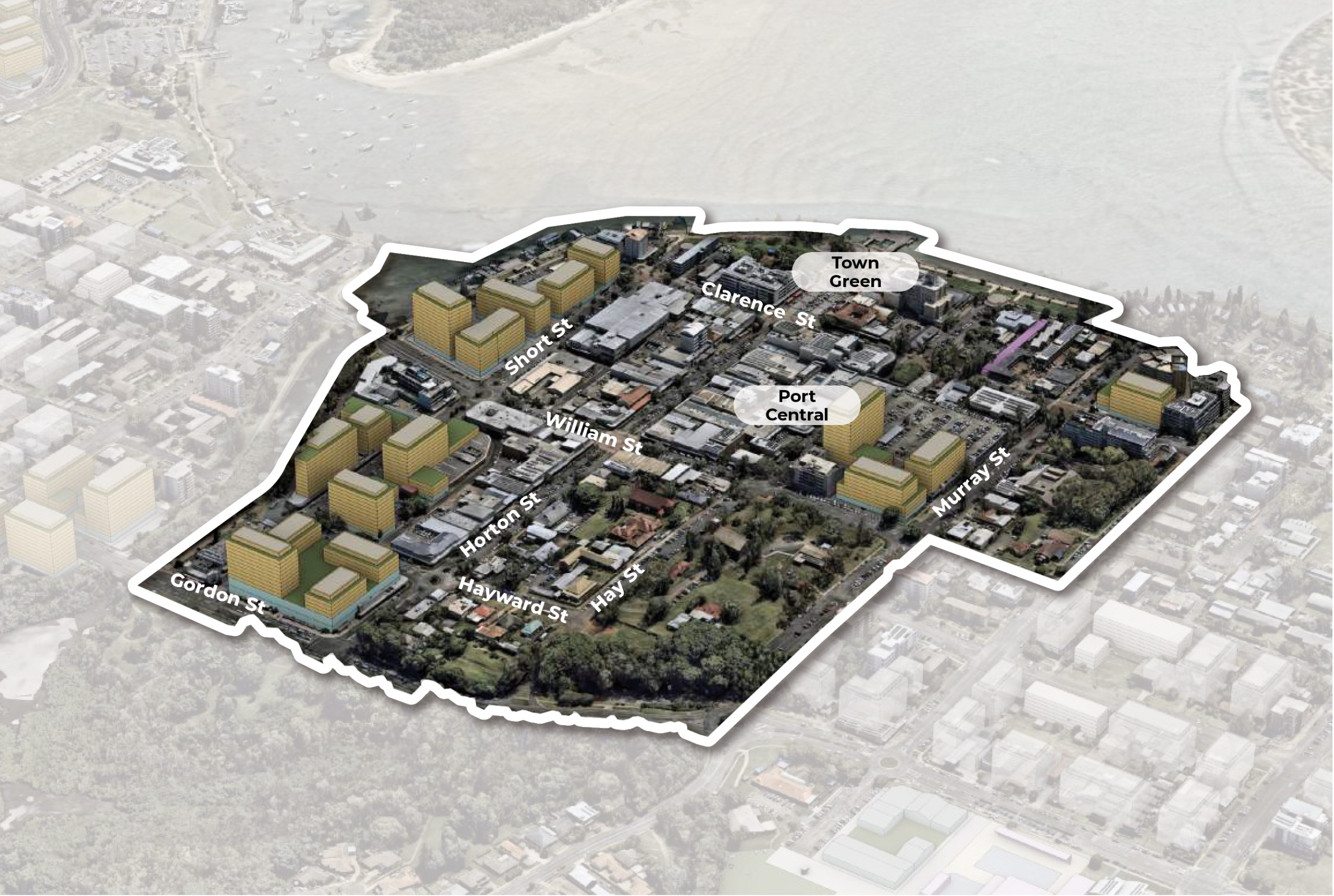
Port Macquarie-Hastings Council’s City Heart Master Plan reflects a clear intent to support a more vibrant and economically active city centre, with planning focused on improving liveability, encouraging activation and facilitating additional housing and mixed-use development within the CBD (Port Macquarie-Hastings Council, 2025).
This marks a notable shift in direction. Rather than viewing the city centre purely as a retail and tourism destination, planning policy is increasingly positioning the CBD as a mixed-use precinct capable of accommodating greater residential density, employment and commercial activity.
For existing property owners, this may improve the long-term strategic relevance of well-located CBD assets, particularly those with redevelopment potential or flexibility for repositioning over time.
Development proposals are beginning to test the market
The proposed 29 Park Street development has become one of the clearest examples of this emerging shift. While still subject to planning processes, the scale and nature of the proposal, incorporating height uplift, residential apartments, hotel accommodation and commercial uses, demonstrates growing market confidence in more intensive urban outcomes within Port Macquarie’s CBD (NSW Planning Portal, 2026).
Importantly, individual projects should not be viewed in isolation. Whether this exact proposal proceeds or not, developments of this scale indicate the private market is increasingly willing to test denser mixed-use outcomes in locations that have historically remained relatively low rise. That is often one of the earliest indicators of a broader market transition.
Population growth and tourism are increasing pressure on the city centre
Port Macquarie’s population is forecast to grow by 28,000 residents by 2046, while the region continues to attract more than 1.5 million visitors annually (Port Macquarie-Hastings Council, 2025). As a result, the CBD is being asked to perform more functions simultaneously, operating not only as a tourism and hospitality destination, but increasingly as a residential, employment and service hub for a growing regional population.
This has important implications for commercial property. Greater residential density within and around the CBD can improve trade consistency for retail and hospitality operators by broadening the customer base beyond seasonal tourism alone. It can also strengthen demand for centrally located office and service accommodation as businesses seek proximity to amenity, clients and supporting infrastructure. For investors and landlords, a more active and densely populated CBD typically supports stronger tenant demand over time, particularly where mixed-use activation improves amenity and pedestrian traffic.
A measured transition, not an overnight transformation
Port Macquarie’s CBD is not about to become a high-density metropolitan centre overnight. Growth is likely to remain selective and gradual, shaped by planning controls, infrastructure capacity, development feasibility and the need to balance intensification with the character of the city’s coastal setting.
However, the strategic direction is becoming increasingly clear. Planning reform, demographic growth and private development activity all suggest Port Macquarie’s CBD is beginning to transition toward a more intensive and integrated urban model than it has historically supported.
For owners and investors
- CBD assets may benefit from stronger long-term strategic relevance as density and activity increase
- Older or underutilised buildings may present repositioning or redevelopment opportunities
For occupiers and tenants
- Improved amenity and activation may enhance the attractiveness of CBD locations
- Greater residential density can support stronger local trade for customer-facing businesses
For developers
- Planning direction is increasingly supportive of mixed-use and intensified urban outcomes in appropriate locations
Port Macquarie’s CBD is still in the early stages of this evolution, but the underlying indicators suggest the city centre may be entering a new development cycle that could reshape how the market views CBD property over the coming decade.
If you own commercial property in the Port Macquarie CBD and are considering your next step, Commercial Collective can help you assess how evolving planning direction and market conditions may influence asset positioning, redevelopment potential and long-term value.