What changing tax settings mean for commercial property investors
Changes to negative gearing, capital gains tax and the proposed taxation of discretionary trusts are creating new considerations for property investors. While commercial property retains an important distinction from residential investment under the negative-gearing reforms, the wider changes may affect how investors structure, hold and eventually sell commercial assets.
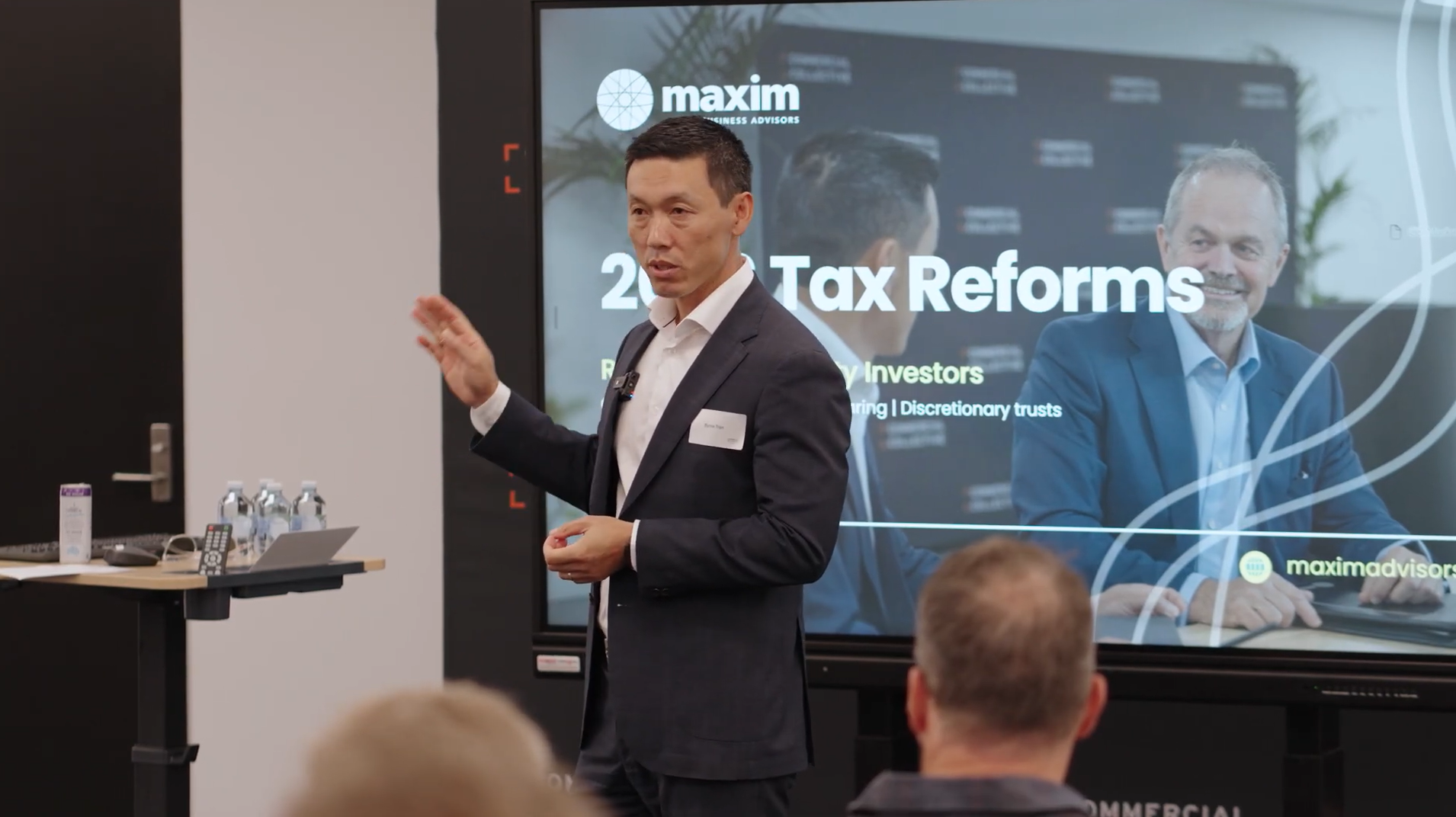
These implications were explored at the Executive Exchange hosted by Commercial Collective in partnership with Maxim Business Advisors. The briefing brought together taxation and commercial property perspectives to consider what has changed, what remains uncertain and how investors can prepare without making rushed decisions.
How the tax changes affect commercial property
From 1 July 2027, negative gearing for residential property will generally be limited to eligible new builds, with transitional arrangements applying to established properties acquired before the Budget-night cut-off. Commercial property will remain subject to the existing negative-gearing rules, creating an important distinction for investors considering different property sectors. “It’s applying to residential property only. Commercial property is excluded from this. If you are negatively geared, you can continue to negatively gear that commercial investment, subject to the existing rules,” said Daniel Sullivan, Principal and Specialist Tax Advisor at Maxim Business Advisors.
This distinction may contribute to greater interest in commercial property, but tax treatment should remain only one part of an investment decision. Commercial assets have different lending requirements, lease structures, tenant risks, vacancy considerations and management responsibilities. The underlying property still needs to suit the investor’s objectives, financial position and risk tolerance. Commercial investors will also need to prepare for changes to capital gains tax. For eligible individuals and trusts, the existing 50% CGT discount will be replaced by cost-base indexation for applicable gains arising from 1 July 2027. A minimum 30% tax rate will also apply to relevant real capital gains.
Transitional arrangements will separate gains arising before and after the commencement date. This may introduce additional record-keeping, valuation and calculation requirements for assets held across both periods. The eventual outcome will depend on factors including the acquisition date, ownership structure, holding period, capital improvements and the investor’s wider tax position. Detailed calculations are best considered through individual tax advice. However, the broader implication is clear: decisions made when acquiring or improving a commercial property may have different consequences when the asset is eventually sold.
Why ownership structures require more planning
The proposed changes to discretionary trusts add another consideration to future investment decisions. From 1 July 2028, the Government proposes introducing a minimum 30% tax on the taxable income of discretionary trusts, subject to exclusions and final implementation details. The reforms do not mean every existing trust should be changed or that one ownership structure will become universally preferable. A decision to acquire property through an individual, company or trust can affect income distribution, asset protection, control, finance and the tax position when the property is sold. This makes the planning undertaken before an acquisition increasingly important.
“If you’re looking to buy assets, that is where we need to put more time into the structure,” Daniel Sullivan advises. The appropriate approach will depend on how the property is being funded, whether it will be occupied or leased, who needs to receive the income, the anticipated holding period and the eventual exit strategy.
Restructuring an existing asset may also create capital gains tax, stamp duty, lending and legal consequences. Investors should therefore obtain advice before entering a contract, rather than attempting to change the ownership structure after an acquisition has been completed. The central message from the briefing was not that investors should rush to sell, acquire or restructure before the reforms commence. It was that future property decisions will require more deliberate planning and closer coordination between taxation, legal, finance and property advisers.
Changing sentiment is creating a more selective market
While the tax changes are significant, their immediate market impact is being felt through investor sentiment and decision-making. Uncertainty around taxation, interest rates and the wider macro environment is causing investors to take longer to assess opportunities. Commercial Collective Co-founder and CEO Dane Crawford said this shift in confidence had occurred without a corresponding change to many of the region’s underlying property drivers.
“The overall fundamentals for commercial and industrial property within Newcastle have not fundamentally changed. What has changed dramatically is the macro environment around policy, and that has shifted sentiment,” Dane said. Investors are placing greater scrutiny on lease terms, tenant quality, capital expenditure, ownership costs and future exit options. This is particularly relevant for secondary assets or properties with unresolved leasing, maintenance or planning considerations.
A more selective market can also create opportunities. When fewer buyers are prepared to act, informed investors may have more time to undertake due diligence, negotiate terms and assess properties that suit a longer-term strategy. Commercial Collective has also observed growing interest from investors with residential property experience. “We’re seeing a lot of curiosity from first-time commercial investors, particularly those who have typically invested in residential,” said Commercial Collective Co-founder and Head of Sales and Leasing Byrne Tran.
In Newcastle, that interest is particularly relevant to the industrial sector, which continues to be supported by constrained land supply, low vacancy and demand from logistics, infrastructure, manufacturing, trade and energy-related businesses. However, curiosity does not immediately translate into a suitable acquisition. Investors entering commercial property need to understand how rental reviews, lease covenants, tenant concentration, recoverable outgoings and potential vacancy periods affect both income and value.
What should investors consider now?
The lead time before the reforms commence provides an opportunity to review existing investments and prepare for future decisions. Property investors should consider whether their records clearly document the original acquisition, capital improvements and other costs that may affect the property’s cost base. Those planning an acquisition should discuss the ownership structure, funding method, income requirements and exit strategy before signing a contract.
Tax settings will influence these decisions, but they should not replace a detailed assessment of the property itself. Location, lease security, tenant quality, building functionality and long-term market demand remain central to commercial property performance. As the reforms take effect, investors who understand both their tax position and the property fundamentals will be better placed to assess opportunities with greater clarity.
If you are reviewing an existing property portfolio or considering your next acquisition, speak with Maxim Business Advisors about the taxation and ownership implications, and Commercial Collective about property strategy, market conditions and suitable opportunities. Seeking advice early can help ensure the proposed structure and the property itself are considered together before any commitments are made.
The information in this article is general in nature and does not constitute taxation, financial, legal or property advice.
Register your interest in future events
Commercial Collective brings investors, business owners and advisors together to discuss the issues shaping commercial property. Register your details below and we’ll let you know when the next event is announced.