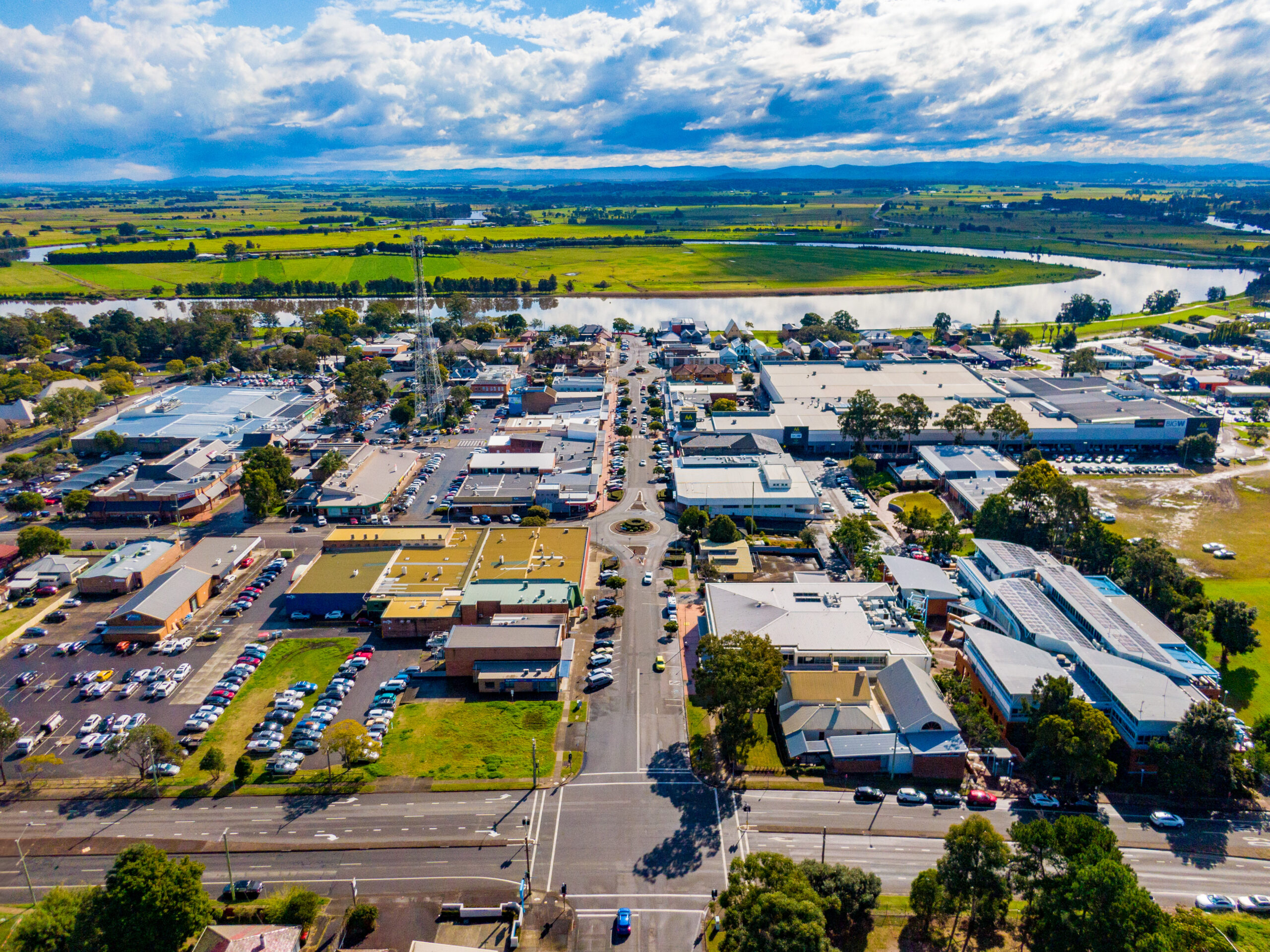
Raymond Terrace market assessment: demand, investment appeal and development potential
Raymond Terrace is gaining relevance within the Lower Hunter’s investment and development landscape, supported by its role as the primary commercial and administrative centre for Port Stephens. Located 26 kilometres north of Newcastle, the town combines relative affordability, civic infrastructure and access to a broader regional employment network. Its appeal is increasingly tied to population growth, improving connectivity, housing demand, nearby employment precincts and Council-led planning that supports town centre renewal. For investors and developers, the opportunity lies in Raymond Terrace strengthening its role as a regional hub, with capacity for future residential, commercial and mixed-use growth.
Raymond Terrace market position and demand
Raymond Terrace plays a central role within the Port Stephens local government area, which had an estimated population of 76,000 residents in 2023. The town itself is home to around 14,000 residents and acts as the LGA’s primary service centre, supporting a broad catchment across retail, healthcare, government, professional services and community infrastructure (ABS, 2023). This civic and service function gives Raymond Terrace a more stable base than many smaller regional towns. The town centre accommodates Port Stephens Council’s administration centre, Service NSW, Raymond Terrace Local Court, the local police station, healthcare facilities and electoral offices. These uses generate consistent weekday activity, support local employment and help underpin demand for surrounding commercial services (Port Stephens Council).
Raymond Terrace Marketplace, supported by national retailers including Woolworths, Big W, Aldi and Dan Murphy’s, further reinforces the town centre’s role as the dominant retail and convenience hub for the surrounding population. This retail base is complemented by medical providers, financial institutions, food operators, professional services and community facilities.
Why this matters: Raymond Terrace has the base functions investors typically look for in a regional centre: government services, retail anchors, healthcare, transport access and an established residential catchment. These uses create repeat visitation and provide a stronger foundation for future commercial and mixed-use development.
Connectivity and regional employment access
Connectivity is one of Raymond Terrace’s strongest market drivers. Positioned near the Pacific Highway and key arterial connections, the town provides efficient access to Newcastle, Maitland, Heatherbrae, Tomago, Williamtown and the Newcastle Airport precinct, placing it within reach of some of the Hunter’s major employment and industrial areas. This includes Heatherbrae’s industrial and bulky goods precinct, Tomago’s manufacturing and logistics base, and RAAF Base Williamtown, which supports around 3,500 military, civilian and contractor personnel (RAAF Base Williamtown Public Information). The M1 Pacific Motorway extension to Raymond Terrace is expected to further strengthen regional connectivity, freight movement and travel efficiency between Newcastle, the Hunter and the Sydney to Brisbane corridor (NSW Department of Infrastructure and Transport).
Implications for businesses: Improved access to regional employment nodes strengthens Raymond Terrace’s appeal for service businesses, healthcare providers, trade users and professional operators looking to service a growing Lower Hunter catchment.
Implications for investors: Infrastructure-led accessibility can support stronger demand over time, particularly where assets are located near established services, transport routes and town centre activity.
Housing demand and affordability
Housing is likely to be one of the most important forces shaping the next phase of Raymond Terrace’s development. Port Stephens Council’s Local Housing Strategy identifies demand for more than 11,000 additional dwellings by 2041, with Raymond Terrace recognised as a key location for infill development and urban renewal (Port Stephens Local Housing Strategy). The appeal is strengthened by Raymond Terrace’s relative affordability compared with several nearby Hunter Region centres. While affordability alone does not create investment performance, it can support demand from first-home buyers, renters, key workers, families, investors and housing providers seeking more accessible entry points within a connected regional market.
This affordability also gives Raymond Terrace a practical role in addressing broader housing supply pressures. The town centre has the potential to accommodate more diverse forms of housing, including infill, medium-density, affordable and social housing, particularly where projects are located close to retail, civic, healthcare and transport services.
Why this matters: Raymond Terrace is not relying solely on greenfield growth. Its investment appeal is increasingly tied to the ability to deliver housing in and around an existing service centre, where new residents can support local businesses, reduce commuting pressure and improve town centre activity. For developers, this creates a more integrated opportunity. Housing supply can be positioned not just as a residential outcome, but as a catalyst for stronger town centre activation, better use of existing infrastructure and a more self-sustaining local economy.
Town centre renewal, planning and mixed-use potential
Raymond Terrace’s town centre has the core ingredients to support more active mixed-use development, including an established retail base, civic infrastructure, healthcare services, public transport links and community facilities. These features create a foundation for residential, commercial and community-oriented projects that improve street activation, pedestrian movement and connections between retail, civic and residential uses.
This potential is supported by the Raymond Terrace Strategy 2015–2031, which identifies Raymond Terrace and nearby Heatherbrae as growth precincts within the Lower Hunter, supported by population growth, infrastructure investment and proximity to Newcastle, the Port of Newcastle and Newcastle Airport (Raymond Terrace Strategy 2015–2031).
The recent Expression of Interest process for 112 Adelaide Street provides a practical example of market interest, with offers received and Council progressing toward a final outcome. More broadly, Raymond Terrace’s opportunity is not only about site availability, but about delivering projects that respond to clear town centre needs, including housing diversity, active ground-floor uses, improved amenity and better integration with established services. Public-sector planning direction can help establish confidence, but private investment will be critical in translating that direction into built outcomes (Port Stephens Council).
Raymond Terrace investment assessment
Raymond Terrace presents a measured investment case, built around practical fundamentals rather than short-term speculation. Its appeal is underpinned by its role as the administrative and commercial centre of Port Stephens, its connectivity to major employment precincts, its relative affordability and its capacity to accommodate additional housing and town centre development. For investors, the market offers exposure to a regional centre with stable civic and retail anchors, improving infrastructure and potential for long-term demand growth. For developers, the opportunity sits in projects that can align with demonstrated needs, particularly housing diversity, mixed-use activation, community services and employment-generating uses.
The strongest opportunities are likely to be those that respond directly to Raymond Terrace’s existing function. Projects that strengthen the town centre, support local employment, improve housing choice and integrate with established services are more likely to align with the market’s long-term direction. Raymond Terrace should not be assessed as a direct substitute for Newcastle, Maitland or larger metropolitan markets. Its appeal is different. It offers a more accessible regional investment proposition, supported by public-sector direction, improving connectivity and a clear need for development that can support the next stage of population and service growth.